Published on Sun, Nov 1, 2026 | Last updated Sun, Nov 1, 2026 12:05 UTC, 1,223 words | 5 min read | Revision: 1
The Transparency Files are a series of articles based on the publicly released Epstein Files.
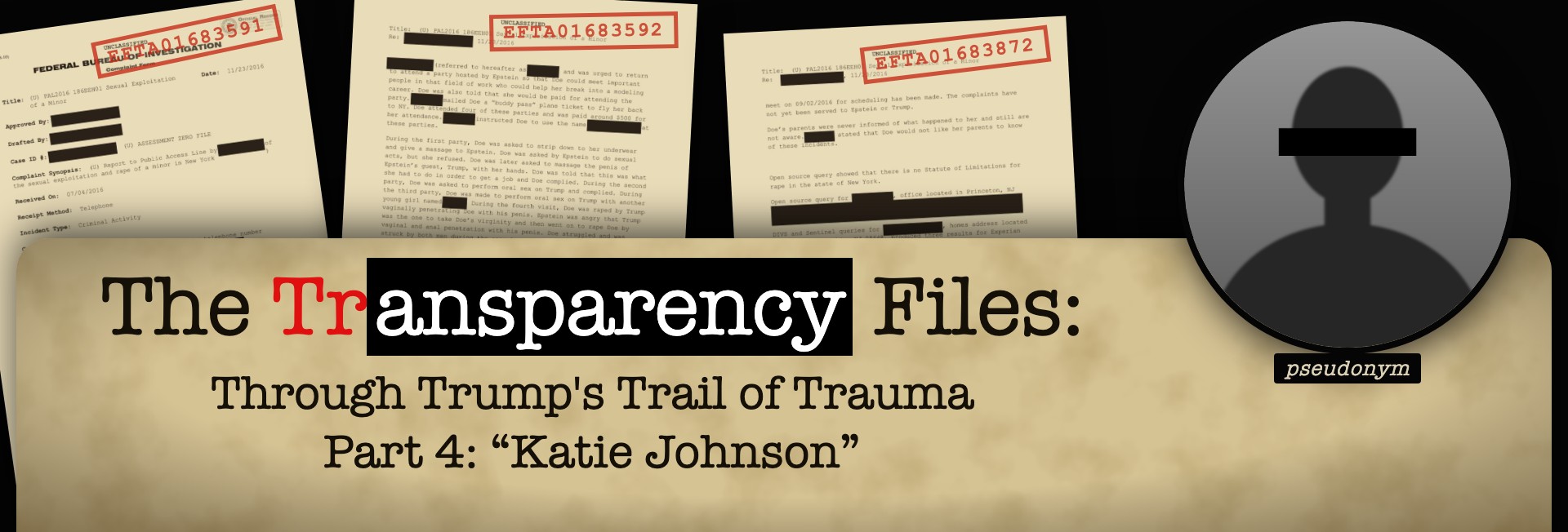
Through Trump’s Trail of Trauma, Part 4: Katie Johnson
A woman says Trump and Epstein raped her in New York in 1994, when she was 13. Her lawsuit and the FBI’s complaint form are both in the files
[Trigger warning: this article retells allegations of child sexual abuse and rape. Please look after yourself.]
Part 4 of 5. Five women named by the House Judiciary Democrats’ report of Monday, October 26, 2026 as direct accusers of Trump.
TLDR; Under the pseudonym “Katie Johnson”, a woman says Trump and Epstein abused her at four parties in New York in the summer of 1994, and that both men raped her. She was 13. Her 2016 lawsuit is in the files, and so is the FBI form her lawyer’s call produced. The two copies of that form are redacted differently.
The HJC October 2026 report is from the minority staff of Rep. Jamie Raskin on the House Judiciary Committee. The full committee did not adopt it. It is a partisan document. It calls her “Jane Doe 2 (a.k.a. Katie Johnson)” (p. 24). “Katie Johnson” is a pseudonym. A White House spokesperson, Lauren Bis, told Newsweek: “None of these allegations are true.”
Her account
Her lawyer called the FBI’s Public Access Line on Monday, July 4, 2016. The complaint form that call produced is dated Wednesday, November 23, 2016 (EFTA01683591 (torrent), DS10).
It says that in the summer of 1994, after seventh grade, she took a bus from her father’s home in the Midwest to New York to start a modelling career. While she waited for the bus home, someone urged her to come to a party hosted by Epstein, where she could meet “important people”. She went to four parties and was paid around $500 for her attendance.
At the first party she was told to strip to her underwear and massage Epstein. Then she was told to massage Trump, and that “this was what she had to do in order to get a job”. At the second and third parties she was made to perform oral sex on Trump. The form goes on: “During the fourth visit, Doe was raped by Trump.” Epstein “was angry that Trump was the one to take Doe’s virginity and then went on to rape Doe”. She “struggled and was struck by both men”, and both threatened her: “We’ll make you disappear like [redacted]”, a name the FBI redacted. Her parents, the form says, were never told.
The paper trail
Her own complaint is in DOJ’s January 2026 release (EFTA00622303 (archive), DS9). She filed it without a lawyer in California federal court on Tuesday, April 26, 2016. It puts the events between June and September 1994, at Epstein’s New York residence, when she was “only a minor of age 13”. The complaint and the FBI form agree on her age, the summer, the city and the closing order: rape by Trump, then an assault by Epstein. The complaint calls Epstein’s assault rape but also describes it as an attempt she “repelled”; the form describes penetration.
The California suit was dismissed in May 2016. A refiled New York suit, brought as “Jane Doe”, was voluntarily dismissed on Friday, November 4, 2016. Two days earlier she had pulled out of a press conference; her lawyer, Lisa Bloom, cited death threats (BuzzFeed News). No court heard her evidence.
Trump’s side had answered at the start. In April 2016 Trump’s lawyer Alan Garten called the claims “categorically false” and said there was “no evidence that the person who has made these allegations actually exists” (quoted in EFTA01433755 (torrent)).
The FBI agent who took the call searched the case system: “Sentinel query for cases involving Jeffrey E Epstein and Donald J Trump regarding exploitation of minors produced case no.: 31E-HQ-C1461253.” (EFTA01683872 (torrent)) The report prints the same number, calls it one of several case numbers tied to Epstein’s 2007 federal investigation, and says sources in the Trump administration confirm that documents linked to it have been withheld from Congress and the public (p. 25 and fn. 79).
What DOJ’s releases leave out
DOJ’s January 2026 release holds two copies of the form, redacted differently. One (EFTA01683870) shows the case number twice. The other (EFTA01683591) boxes it out in both places.
Both copies log the call to an “ASSESSMENT ZERO FILE”. The number boxed out of one copy is the case whose documents, the report says, are withheld from Congress and the public. Besides this form, the report counts one other document DOJ or FBI has produced under that number (fn. 79).
The form is not the only gap. Maria Farmer’s 1996 and 2006 FBI reports are not in DOJ’s January 2026 release (p. 27); DOJ held back another accuser’s FBI interviews until Thursday, March 5, 2026, after saying they had been “incorrectly coded as duplicative” (ABC News); and DOJ re-redacted files after publishing them (DOJ Post-Release Re-Redactions, February 2026).
Why this matters
In April 2016 Trump’s lawyer said there was “no evidence that the person who has made these allegations actually exists”. Her lawyer then called the FBI, and the agent who took the call searched the case system for Epstein and Trump together. The search returned a case number, 31E-HQ-C1461253, which DOJ boxed out of one copy of the form and left visible on the other. The report says documents linked to that number have been withheld from Congress and the public.
Two copies of one form, redacted two ways, show how much rests on what DOJ chooses to box. I think the visible record is the tip of the iceberg: on DOJ’s public pages, the video and audio files appear as one-page placeholders reading “No Images Produced”.
I think a foreign power may hold some of that material and use it to steer Trump into wars that serve whoever holds it.
If you vote for candidates who support impeaching and removing Trump, you can help prevent that escalation and give victims like Katie Johnson a path to justice.
Sources
| Document | Description | Dataset |
|---|---|---|
| EFTA01683591 (torrent) | FBI complaint form, dated Wed, Nov 23, 2016: account on page 2 (EFTA01683592), case number boxed on pages 1 and 3 (EFTA01683591, EFTA01683593) | DS10 |
| EFTA01683872 (torrent) | Second copy of the form, page 3 of EFTA01683870 (case number shown here and on page 1) | DS10 |
| EFTA00622303 (archive) | Complaint, Johnson v. Trump, C.D. Cal. No. 5:16-cv-00797, filed Tue, Apr 26, 2016 | DS9 |
| EFTA01433755 (torrent) | 2016 press printout quoting Garten’s statement of Thu, Apr 28, 2016 | DS10 |
The report. House Judiciary Committee Democratic staff, “‘We Have Certain Things in Common, Jeffrey’: The Case Against Donald Trump Emerging in the Epstein Files and DOJ’s Desperate Efforts to Cover it Up”, Mon, Oct 26, 2026, pp. 24, 25 (incl. fn. 79), 27. Full report (PDF).
External. BuzzFeed News, Fri, Nov 4, 2016 (New York dismissal, withdrawn press conference, Lisa Bloom on death threats). ABC News, Fri, Mar 6, 2026 (DOJ’s “incorrectly coded” statement). Newsweek, Mon, Oct 26, 2026 (White House response).
Our own working notes: report cover sheet, Katie Johnson, EFTA01683870 cover sheet.
Published on Sun, Nov 1, 2026 | Last updated Sun, Nov 1, 2026 12:05 UTC, 1,223 words | 5 min read | Revision: 1
The Transparency Files are a series of articles based on the publicly released Epstein Files.
Mirrors: Codeberg Pages | IPFS
Discussion
Discuss on Lemmy: federated, open source, no tracking.
Discuss on Lemmy →